By ikFTech Pakistan 7 min read Digital Marketing
Choosing between Google Ads and Meta ads in Pakistan is one of the most common questions business owners ask once they decide to spend money on online advertising. Both platforms can bring customers. Both can also waste your budget quickly if they are used for the wrong job.
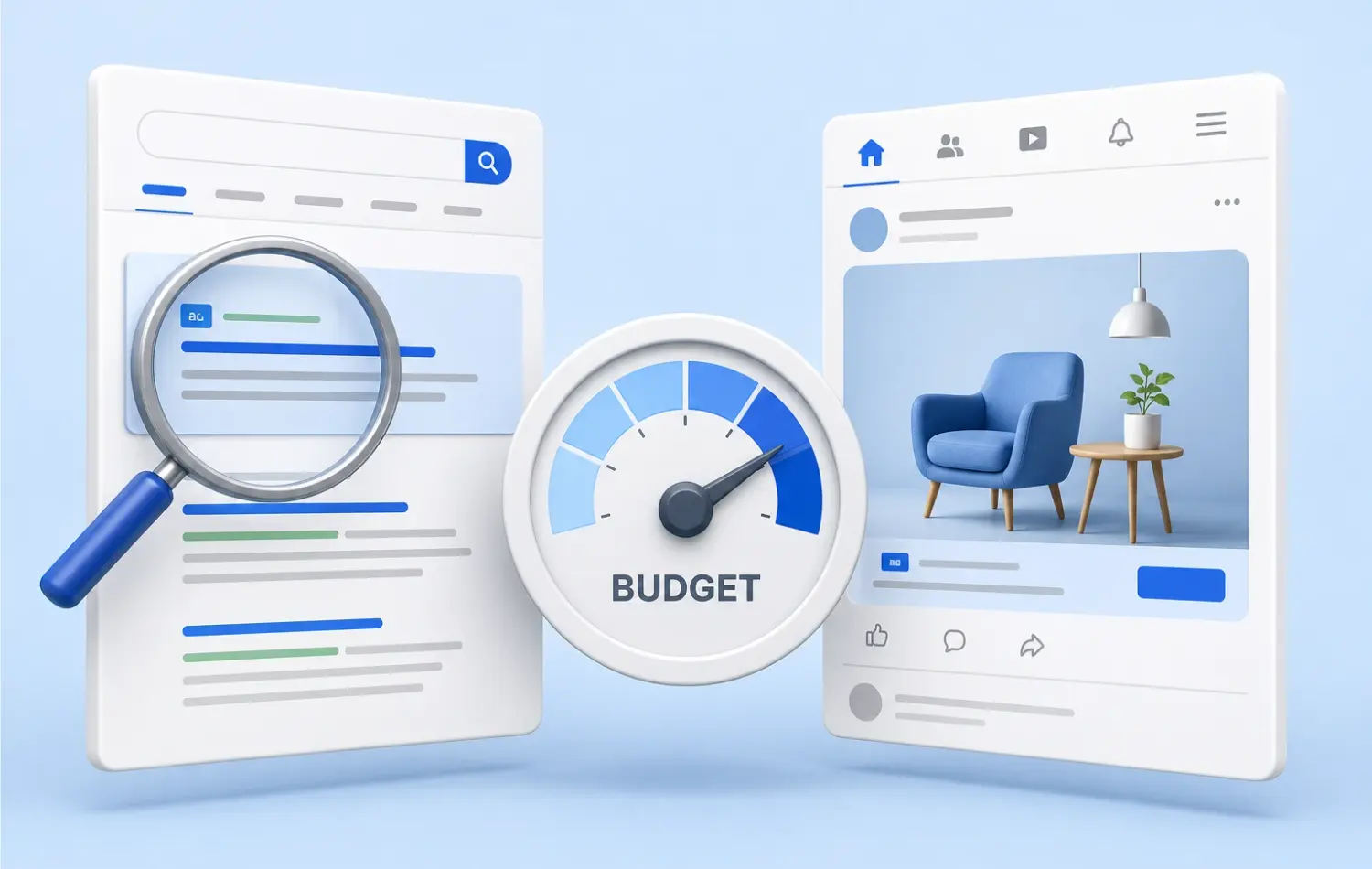
The short answer is this: Google Ads is strongest when people are already searching for what you sell, and Facebook and Instagram ads are strongest when you need to put your product in front of people who are not looking yet. A plumber in Karachi and a clothing brand in Lahore face very different buying journeys, so the right choice depends on how your customers decide to buy.
This guide compares the two platforms side by side, explains which businesses tend to suit each one, and gives you a practical way to split your budget without guessing.
The core difference: capturing demand vs creating it
The simplest way to think about the two platforms is intent.
Google Ads captures existing demand. Someone types “AC repair near me” or “dental implant cost Islamabad” into Google. They have a need right now, and your ad appears at the moment they are looking for a solution. You are competing for attention, but the interest already exists.
Meta ads create demand. Someone is scrolling Instagram or Facebook, not looking for anything in particular. Your ad interrupts that scroll with a new dress, a weekend deal or a course they had not considered. You have to earn their attention and spark the interest yourself.
Neither approach is better in general. A product people search for every day suits search ads. A product people buy on impulse or discover visually often suits social ads. Many established businesses use both, but small budgets usually work best when focused on one platform first.
How each platform works
Google Ads
Google Ads covers several ad types, and it helps to know which ones matter for smaller businesses:
- Search ads: text ads that appear on Google results for keywords you choose. This is where most small businesses should start.
- Performance Max: an automated campaign that spreads your ads across Search, YouTube, Display, Maps and Gmail. It can work well once you have reliable conversion tracking, but it gives you less control.
- YouTube ads: video ads, useful for awareness and for products that need explaining.
- Display ads: banner ads on websites and apps, mainly useful for retargeting past visitors.
You pay mainly per click, and the cost of each click depends on how many advertisers are competing for the same keywords and how relevant your ad and landing page are.
Meta ads
Meta ads run across Facebook, Instagram, Messenger and the Audience Network, managed in one place through Meta Ads Manager. You choose an objective, such as awareness, traffic, leads, messages or sales, and Meta’s system shows your ads to people most likely to take that action.
For Pakistani businesses, click-to-WhatsApp and click-to-Messenger ads are especially useful. Many customers prefer to ask questions in a chat before buying, and these ads open a conversation directly instead of sending people to a website.
Side-by-side comparison
| Factor | Google Ads | Facebook and Instagram ads |
|---|---|---|
| User intent | High: people are actively searching | Lower: people are browsing and discovering |
| Best for | Services, urgent needs, B2B, high-value enquiries | Visual products, offers, impulse buys, brand awareness |
| Targeting | Keywords, location, device, time of day | Location, age, interests, behaviours, lookalike audiences |
| Creative needed | Mainly text, plus a strong landing page | Eye-catching images and short videos, refreshed often |
| Typical action | Call, form submission, website purchase | Message, lead form, website purchase, follow |
| Speed to first results | Often fast if keywords are right | Usually needs a period of creative testing |
| Main risk | Paying for irrelevant clicks from broad keywords | Lots of engagement that does not turn into sales |
Which businesses suit which platform
These are general patterns rather than rules, but they hold up well in practice.
Businesses that usually start well with Google Ads:
- Home services such as AC repair, plumbing, pest control and solar installation
- Clinics, labs and specialist doctors, where people search by treatment and area
- B2B suppliers, software providers and industrial services
- Property developers and agents targeting people searching for specific areas or project types; see our work with real estate businesses
- Travel agencies and tour operators for searches such as Umrah packages or northern area tours
Businesses that usually start well with Meta ads:
- Clothing, footwear, jewellery and beauty brands
- Home bakeries, restaurants and food delivery
- Home décor, gifts and seasonal products for Ramadan, Eid and weddings
- Events, workshops and short courses
- New products that people do not yet know to search for
If your business sits in the middle, look at your current customers. If most of them say “I found you on Google”, double down on search. If they say “I saw you on Instagram”, social is probably your stronger channel. Our guide to social media marketing for small businesses in Pakistan covers the organic side of that channel in detail.
Budgets and costs in Pakistan
There is no universal cost per click or cost per lead. Prices vary by industry, city, season and competition. Keywords in competitive sectors such as property, education and medical treatment can be noticeably more expensive than niche local services, and Meta costs often rise around Ramadan, Eid and major sale periods as more advertisers compete for attention.
As an indicative range only, many small and medium businesses test one platform with roughly PKR 30,000 to 100,000 a month. Smaller tests are possible, but very small budgets make it hard to collect enough data to know what is working.
A more useful way to set your budget is to work backwards:
- Estimate how much a new customer is worth to you, including repeat purchases.
- Decide the maximum you can afford to pay to win that customer.
- Estimate how many enquiries you need to get one customer.
- Use those numbers to set a target cost per lead and judge campaigns against it.
Also factor in billing. Ad platforms may charge in PKR or a foreign currency depending on account setup and payment method, and bank charges or taxes on card payments can add to the real cost. Check these details with your bank before you start.
Tracking: the part most businesses skip
Without tracking, you are guessing. Both platforms can optimise towards results only if they know what a result is.
At a minimum, set up:
- Google Analytics 4 on your website, so you can see where visitors come from and what they do
- Google Ads conversion tracking for form submissions, calls and purchases
- Meta Pixel, and ideally the Conversions API, so Meta can see sales and leads from your ads
- A simple lead log for WhatsApp and phone enquiries, noting which ad or platform each one came from
Your landing page matters just as much. A slow, confusing page will waste clicks on either platform, especially on mobile data connections. Our explainer on website speed and Core Web Vitals shows what to fix, and our web and mobile solutions team builds landing pages designed to convert.
A practical way to split your budget
If you are starting from zero, this phased approach keeps risk low:
- Pick one platform based on whether customers search for you or discover you.
- Run a focused test for four to eight weeks, with tracking in place and a clear target cost per lead or sale.
- Optimise: cut keywords, audiences and creatives that do not convert, and move budget to what does.
- Add the second platform once the first is profitable, often in a supporting role. For example, a search-first clinic might use Meta to retarget website visitors, while a social-first fashion brand might add Google search for people typing its brand name.
- Review monthly, shifting budget towards whichever platform delivers customers at the lowest sustainable cost.
Common mistakes to avoid
- Using broad keywords on Google that attract searches unrelated to your business
- Forgetting to add negative keywords such as “free”, “jobs” or “course” when they do not apply
- Running the same tired creative on Meta for months
- Judging Meta ads by likes rather than messages, leads or sales
- Targeting the whole of Pakistan when you only deliver or serve a few cities
- Turning campaigns off after a few days before the platforms have had time to learn
Key takeaways
- Google Ads captures people already searching; Meta ads put your offer in front of people who are not looking yet.
- Service businesses and urgent needs usually suit search ads, while visual and impulse products usually suit Meta.
- Start with one platform, a clear budget and a target cost per lead before adding a second.
- Tracking and a fast, clear landing page matter as much as the ads themselves.
- Review results monthly and move money towards what brings real customers, not clicks or likes.
The right platform is the one that matches how your customers buy, backed by proper tracking and honest measurement. If you would like help deciding where to start, our digital marketing services cover both search and social campaigns. Book a free consultation and we will look at your goals, budget and market with you before you spend a rupee.