By ikFTech Pakistan 7 min read Mobile Apps
Sooner or later, almost every growing business in Pakistan faces the same question: should you build a mobile app or website first? Customers spend much of their day on their phones, competitors seem to be launching apps, and a developer has probably told you that “everyone needs an app now”. At the same time, budgets are real, and you want the first investment to bring in customers rather than sit unused.
The short answer is that most businesses should start with a fast, mobile-first website and add an app later, once there is a clear reason for people to open it again and again. There are genuine exceptions, though, and getting the order right can save you months of work and a large part of your budget.
This guide walks through how each option works, what each one costs to run, when an app really should come first, and a practical roadmap that lets you grow from one to the other without wasting what you have already built.
Why a website is the right starting point for most businesses
A website is the foundation that nearly every other marketing activity relies on. When someone in Karachi searches for “AC repair near me” or a parent in Islamabad looks up tuition centres, they are searching on Google, not in the app store. A website can appear in those results; an app, for the most part, cannot.
A website also removes friction. Anyone can open a link shared on WhatsApp, Instagram or Facebook in a second, without downloading anything, creating an account or worrying about storage space on an older phone. For a first-time visitor who simply wants your prices, location or menu, that is exactly the experience they want.
There are practical advantages too:
- Discoverability. Websites can rank in search, appear on Google Maps listings and be linked from other sites.
- Shareability. A single URL works on every device and every messaging app.
- Advertising. Google and Meta ads need a landing page, and a website is the natural destination.
- Lower cost and faster launch. One build serves Android, iPhone and desktop users at once.
- Easier updates. Changes go live immediately, with no app store review.
If you are still working out what a site of this kind might cost, our breakdown of website development costs in Pakistan explains the main factors that move the price.
When a mobile app should come first
Some businesses really are app-first, and forcing them into a website-only model would hold them back. An app tends to deserve priority in these situations.
The product is the app
If your service only works through an app, such as ride booking, food delivery with live rider tracking, a fitness programme with daily workouts or a marketplace where vendors manage orders on the go, then the app is not a marketing channel. It is the product itself. In these cases you build the app first, with a simple landing website alongside it.
People will use it frequently
Apps earn their place on a phone when customers come back often. A pharmacy chain where regular customers reorder monthly medicines, or a school whose parents check attendance and fee updates every week, can justify an app because usage is habitual. If customers only need you once or twice a year, very few will keep your app installed.
You need deep device features
Apps can access phone features more reliably than websites: background location, Bluetooth devices, advanced camera functions, biometric login and robust offline storage. A field-sales team in rural areas with weak connectivity, for example, may need an app that records orders offline and syncs later.
You already have a loyal audience
If you already have thousands of repeat customers, an app can deepen that relationship with loyalty points, saved preferences and push notifications. The audience comes first; the app then serves them better.
Comparing an app and a website side by side
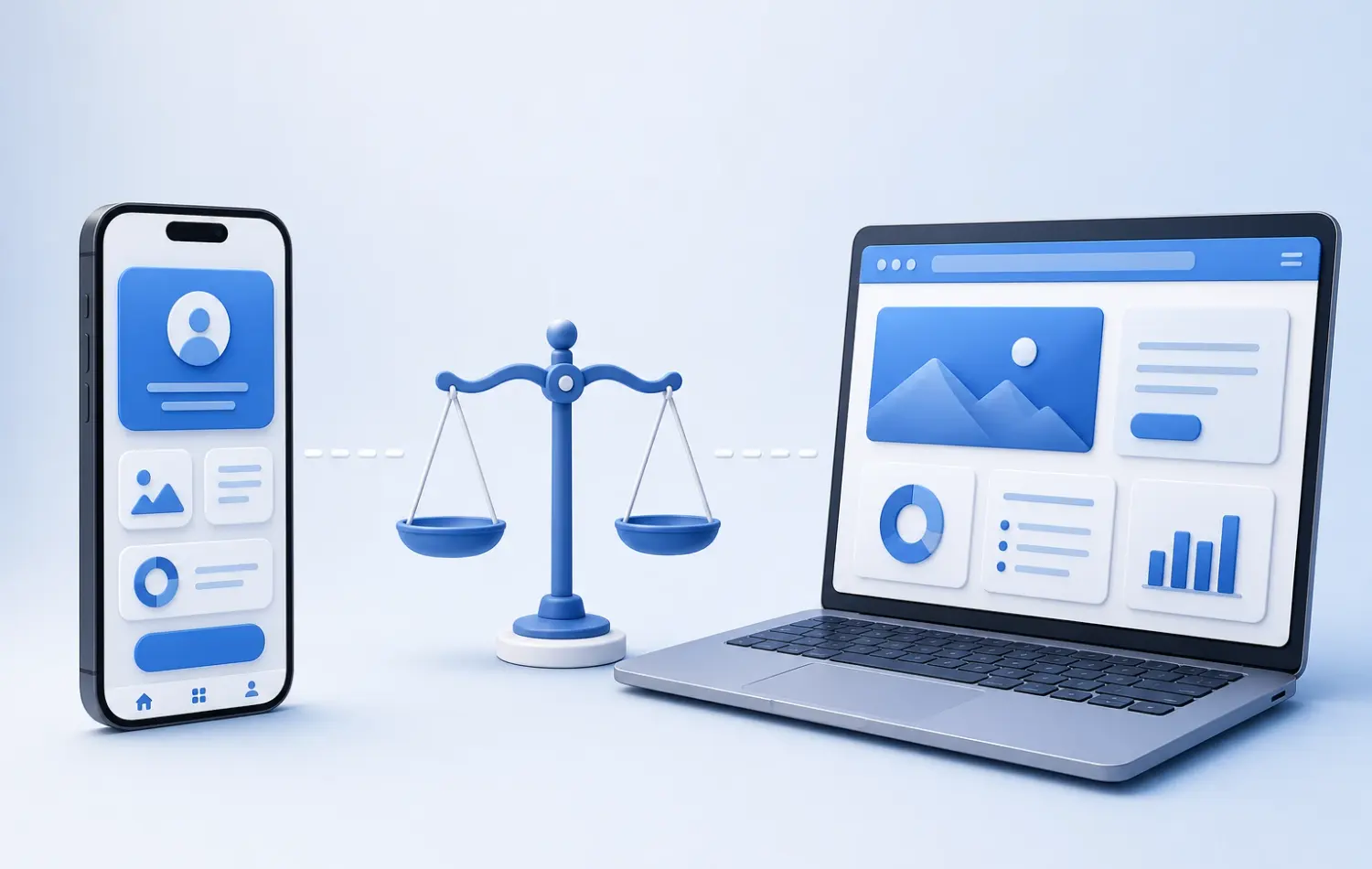
The table below summarises how the two options usually compare. Treat it as a general guide, since a complex website can cost more than a simple app.
| Factor | Website | Mobile app |
|---|---|---|
| How people find it | Google search, maps, ads, shared links | App store search, ads, referrals |
| Barrier to first use | None, opens instantly | Download, install, often sign-up |
| Typical launch time | A few weeks | Usually a few months |
| Platforms covered | All devices with one build | Android and iOS need separate builds or a cross-platform framework |
| Updates | Live immediately | Often need store review and user updates |
| Repeat engagement | Moderate, relies on email, social and search | Strong, with push notifications and home-screen presence |
| Device features | Good and improving | Full access |
| Ongoing costs | Hosting, domain, maintenance | Backend, store accounts, OS updates, maintenance |
On cost, indicative ranges help set expectations. Depending on scope, a professional business website in Pakistan might fall somewhere between roughly PKR 80,000 and PKR 400,000, while a custom app with its own backend often starts several times higher and can run into the millions. These figures are only a rough guide; your requirements decide the real number.
Remember the running costs as well. Publishing on the Google Play Store needs a developer account with a one-time fee, and the Apple App Store charges an annual developer membership. Each new Android or iOS version can also require updates to keep the app working smoothly.
The middle path: mobile-first websites and progressive web apps
The choice is not always binary. Many businesses get most of the benefit of an app with a carefully built website.
A mobile-first website is designed for small screens from the start: large tap targets, quick-loading images, simple checkout and click-to-call buttons. In Pakistan, where many users browse on mid-range Android phones and patchy mobile data, this alone makes a noticeable difference to enquiries and sales.
A progressive web app (PWA) goes a step further. It is a website that can be added to the home screen, load quickly on repeat visits, work partly offline and, on supported devices, send notifications. For a restaurant, a salon or a retail brand, a PWA can deliver much of the “app feel” at a fraction of the cost.
PWAs do have limits. Support for some features varies between Android and iOS, and they do not appear in app stores in the same way as native apps. But as a stepping stone, they let you test whether customers want app-like features before committing to a full build. Our web and mobile solutions team often recommends this route for businesses that are unsure.
Questions to ask before you decide
Before choosing, sit down with your team and answer these questions honestly.
How often will customers use it?
If the honest answer is “a few times a year”, start with a website. If it is “several times a week”, an app may be justified.
Where will your first customers come from?
If you expect new customers from Google searches, ads or social media posts, they will land on a website first. Investing in search visibility, as covered in our local SEO starter guide, will usually bring more early leads than an app nobody has heard of.
What does the app do that a website cannot?
Write down the specific features. If every item on the list can be done on a well-built mobile website, you may not need an app yet.
Can you support it after launch?
An app is not a one-time purchase. Budget for bug fixes, operating system updates, server costs and new features. A neglected app with poor reviews can harm your brand more than having no app at all.
Who will promote it?
Apps need marketing just like websites. Getting people to install an app takes ads, in-store prompts, social media and incentives, especially around busy periods such as Ramadan and Eid.
A sensible roadmap from website to app
For most businesses, a phased plan reduces risk and keeps each investment useful.
- Launch a fast, mobile-first website. Include clear service pages, contact options, Google Business Profile integration and basic analytics.
- Build traffic and learn from data. Use search, social media and ads to bring visitors, then study which pages they use and what they ask for.
- Add app-like features on the web. Customer accounts, order history, saved addresses or a PWA layer can test demand cheaply.
- Build the app when the case is clear. Once repeat customers are asking for it, or a feature truly needs a native app, move ahead with mobile app development, reusing the same backend and content where possible.
If you reach step four, the next decision is usually the technology. Our comparison of Flutter vs native app development explains the trade-offs between one shared codebase and separate Android and iOS builds.
Planning the backend with growth in mind from the start is worthwhile. If your website stores products, bookings or customer data in a well-structured system, a future app can connect to the same data through an API rather than starting from scratch.
Key takeaways
- Most Pakistani businesses should build a fast, mobile-first website before a mobile app.
- A website wins on discoverability, shareability, launch speed and cost.
- An app should come first when the product is the app, usage is frequent or deep device features are essential.
- Progressive web apps offer a useful middle path to test app-like features cheaply.
- Budget for ongoing maintenance, store accounts and marketing, not just the initial build.
- Plan your backend so a future app can reuse the same data and logic.
Choosing between a mobile app or website first is ultimately a question of where your customers are today and how often they will come back. If you would like a second opinion on your plans, book a free consultation and we will help you map out the right order for your business.